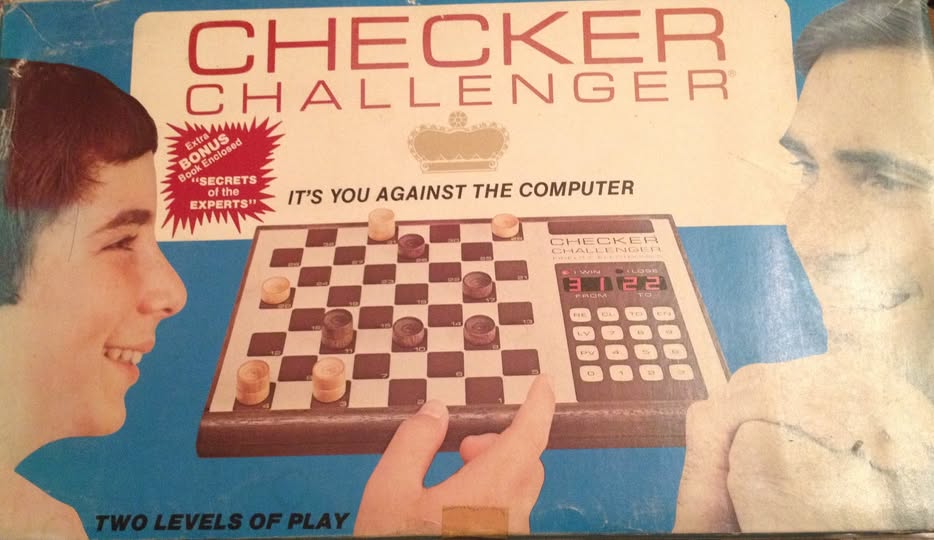
Fidelity Electronics - “Checker Challenger,”
the forerunner of most decent
checker programs consider worthy of playing by a checker player. Most of
them at this time were toys. The Fidelity's checker playing machine had been
around since 1975 and a number of Master players knew about the program and were
able to easily beat it, so when Fidelity Electronics Ltd. from Chicago, Illinois
made their premier introduction in 1978 at the
3-Move Murfreesboro, TN ACF National they contributed $5,000 to the prize fund and they want to enter
“Checker Challenger” in the Master Division. This
was the first time ACF decided to let a computer play in the US National. ACF officials and several Master Players said it shouldn't play
at that high level of competition since a number of Masters knew it's ability
and what level it
played at. This didn't suit Fidelity Electronics but they conceded to play
in the Minors anyway. As it turn out,
“Checker Challenger” placed
down in the pack below 20th place, but they did sell a number of machines. Jules Leopid from Palm Beach, FL a checker celebrity champ, and endorser of the “Checker Challenger”
Program which Sears later sold both their chess and checker machine. It was a fun program but not Master
level. In 1986 Chinook and Checkers 1.0
were developing into stronger programs. In 1989 David Levy of Chess and
Computer Chess Fame sponsored the first Computer Olympiad in London (a
tournament for intelligent computer programs) which 6 checker (draughts)
programs competed in that division at the Olympiad. Jonathan Schaeffer of
the University of Alberta at Edmonton entered their baby Chinook, a hurriedly
developed checker program that ran on a Sun SPARC machine. Gil Dodgen's
Checkers 1.0 program ran on a Macintosh “Mac II” and Dave Butler's program ran on an old eight-bit Atari. Chinook was 1st, and
took the gold medal, Checkers 1.0 took 2nd placed and silver, and
Dave's program placed 3rd as bronze, which opened up new competitiveness in the
interest of computer checker programs. After this, ACF hosted US 1990 Nationals and
again allowed computers to enter their US National Tournament. Chinook placed second and Checkers Experimental (second-generation
Checkers 1.0 program) tied 6th/7th
in that year's National. Gil Dodgen, partners with Cornell thus Cornell Checkers was
possible with more improvements, and
a faster computer with some endgame databases. By 1992 US
Nationals Cornell Checkers placed 3rd in Masters, as a result
of this performance it was offered for sale as a package on a Cornell Computer,
a PC with 256K cashe, 8mb of RAM. Gil Dodgen later offered this program as
World Champion Checkers (WCC) for DOS Windows and Macintosh iOS MAC PC's when the Cornell Computer Systems
stopped selling their checker computer. WCC was later improved again by Gil
Dodgen and Ed Trice as WCC Gold and Platinum III which is now a free download off the
internet. The
WCC Story I should also mention there were some good respectable
checker & draughts programs being developed in the early 90s in Europe like: Checkermate in 1989, Sage, then Blitz, Dynamo Pro in 1992 by Adrian Millett.
Colossus Draughts program was written by Martin Bryant, UK (1992), and Nexus (1998), a forerunner of Nemesis (2002) by Murry Cash, and Wyllie Draughts
(1991) program by Roberto Waldteufel, the Aurora Borealis Draughts Program, introduced in 1999
and with continued improvements, and
possibly the best or seems to be the best database of choice.
Aurora Borealis Draughts has continued to improve, and they're a favorite of ACPA
“Pool Checkers.” Aurora Borealis 4, “Aurora Borealis Draughts professional” lets you work with 14 draughts variations
(English, Italian, Russian, Brasilian, Czech, Pool, Spanish, Thai, Turkish, International,
Killer, Frisian, Spantsireti and Canadian), play with advanced computer partner, analyze, easily comment games, and create your own games databases!
Most ACF Checker Players prefer Checkerboard w/Cake & Kingsrow engines since this
program and these engines continue to be updated, and they offers a 10 piece database
and a huge opening book. 5/13/19 Ed Gilbert added machine learning (ML) to
Kingsrow's 10 piece endgame db and compress it again saving 85GBs, improved his
2M position open book db which covers all 174 of 3-move openings, and it
includes the merger of "book 10" egdb library and the auxiliary MTC & DTC db. Also read
“Kingsrow”
Abbreviations
|
BACK HOME